
If you’re a Hunger Games fan with a habit of intensely overanalyzing your favorite fiction, you will love The Panem Companion! It’s an in-depth look at every level of the Hunger Games universe. It begins with musings on how Panem could have evolved from our current society (including maps and graphs), and goes on to examine the social, economic, and political structures of Panem, as exhibited both in the society as a whole and in the individual lives of the characters. Some of the topics I found most interesting were: district and race relations, the mystery of Cinna’s origins and true role in the rebellion, a comparison of Panem and District 13 (as in, how different are they really?), and the question of who’s ultimately responsible for a certain character’s death. Given Suzanne Collins’ military background and love of Greek and Roman mythology, those parallels are explored as well. As if all this wasn’t enough to chew on, there’s an entire appendix on the origins of the characters’ names. My hat is off to V. Arrow for her thoroughness and insight. I felt a little weird devoting so much brainpower to a work of fiction, but man was it fascinating.
I allowed myself to read this because it’s not actual dystopia, just an analysis of dystopia, but it reminded me of why I need to stay away. I feel even more anxious about the future of our country (and world) than I did before.
I received this book from Netgalley in exchange for an honest review.
1 Comment + Posted in: book reviews

Today I want to tell you a story.
Once upon a time, in a riverside village in a faraway kingdom, lived a young woman. She was neither a princess nor a peasant, making a modest living as an assistant to the innkeeper. She had many friends, and together they enjoyed feasts and nights at the tavern. But her heart belonged to her good friend the town gunsmith. She waited patiently for him to return her feelings. At last he professed his love, and they married amid great joy and celebration. The young woman had every expectation that they would live happily ever after.
As the years passed, the gunsmith spent more and more of his days away from her, engaged in other pursuits. She tried to restore their closeness, but failed time and again. One spring day, the gunsmith informed her that he had taken up with a scullery maid. He proclaimed that he wished to be free for dalliance with this maid, and any other who caught his fancy, as he had never truly loved the young woman at all. Then he took his possessions and left their cottage.
The young woman was heartbroken. While she continued working at the inn and going through the motions of her life, she grieved for her lost love and lost dreams. At times, the support of her friends, and especially of the King (who loved her like a daughter despite her commonness), was all that sustained her. But, slowly, she grew accustomed to her new circumstances and began embracing life again. She redecorated her cottage, traveled around the kingdom, and enthusiastically supported the local jousting team. For many moons, these small joys were sufficient. But the day finally came when the young woman felt ready for companionship, to begin opening her heart to someone worthy of all she had to give.
Unfortunately, in the intervening years, things had changed dramatically in the kingdom. Before her marriage, the young woman had associated with a large group of unmarried men and women, who mingled and treated one another as friends. Now, most of her peers had spouses and families of their own, and the few unmarried men the young woman encountered did not behave as those she had known in her younger years. Her attempts to befriend men she found intriguing were fruitless – they kept their own counsel and did not desire her company.
When she could no longer endure the impression of wearing an Invisibility Cloak, she sought other means of acquaintance with eligible men. These means generally felt more like an interview for employment than a natural conversation between two people. Strangers developed swift attachments to her, demanding her attention and becoming impatient with her hesitance. None of them captured her heart. The young woman felt like a rabbit about to be caught in a huntsman’s trap. Under such conditions, she could never grow to love another as she had loved the gunsmith. She perceived that these eager suitors did not truly care for her as an individual – how could they, when they did not truly know her? – but only saw her as a filler of the empty woman-shaped space in their lives. So she fled from them.
The young woman’s hope and confidence were shaken. A few villagers frowned upon her actions, adding to her distress. Each day she poured out her concerns in a letter to the King, seeking his wisdom and guidance. The curse of her past weighed heavily on her, and she felt doomed to an unhappy choice between old maidenhood and unwanted affections. She wanted to be obedient to the King’s wishes, but they were unclear. And she knew that even if the whole village united in an outcry against her, she could not be untrue to herself or to her dreams.
The King did not reply with advice, only with reassurance that he loved the young woman just as she was. He reminded her that she had an important role to play in the kingdom, even if no one worked alongside her. Though this comforted the young woman, she still felt a quiet, underlying despair. It was now clear to her that the King’s direct intervention would be required if she was ever to take another husband. And who could know the plans of the King? Despite her renewed appreciation of her freedom, she still longed for a good man who would know her and care for her as the King did – someone who would capture her interest, and offer his friendship before seeking to capture her heart. Such a thing now seemed very unlikely, if not impossible.
So, the young woman determined to continue the work that the King had put to her hand. She would count her blessings – her friends, her home, the precious little ones who called her “aunt.” She would not give in to loneliness or the temptation to yield to others’ wishes. She would do the best she could, and trust in the King to provide what she needed to endure. Gathering up her skirts, she fixed her eyes on the horizon and headed out to her fields.
The rest of her story is still unwritten.
4 Comments + Posted in: creative, reflections

“This was a good win. As opposed to that bad win. And if the distinction seems absurd, welcome to another season of Memphis Tiger basketball. This is who we are. This is what we do. We overreact, and overanalyze, and completely overdo it. Every loss means that Pastner can’t coach worth a lick. Every victory means the Tigers are headed for the Sweet 16 at a minimum. If you want perspective, go follow Rice or someone. Memphis basketball isn’t about perspective. It’s about crazy, over-the-top passion.”
– Geoff Calkins
Last night at tipoff, I posted the above picture and paraphrased Anne Shirley, “It’s a brand new season with no mistakes in it yet!” Thankfully, it started on a great note. Go Tigers Go!

Last Saturday night, Derek Webb performed a concert at my church. I took this (blurry as usual) pic while he sang “She Must and Shall Go Free,” a song that’s meant a lot to me in this phase of my life. Most of the concert was a front-to-back performance of his new concept album, Ctrl. (Verdict: Not really my cup of tea, but I appreciate what he’s trying to do.) The opening act and backup band was Page CXVI, who lived up to their hype. Overall, it was an unusual but interesting show.
Between songs, Latifah of Page CXVI talked naturally and insightfully about the creative process and being a creative person. I was surprised to feel envious of her freedom to express herself and her emotions – the good, the bad, and the ugly – through music, and her assurance that that expression is valuable and even glorifying to God. And her assumption that someone will care about it. Most of the time, I don’t feel that way about my writing at all. I rarely get the satisfaction of knowing that I said exactly what I wanted to say, and it meant something. I don’t write what I really think (at least publicly, and often not even to friends) because it’s too negative, too controversial, too personal, and no one really cares anyway. I tend to feel that God isn’t honored by that stuff. But if King David had felt that way, we wouldn’t have a lot of the Psalms. If Alanis Morisette had felt that way, we wouldn’t all still be singing about Dave Coulier 15 years later.

I sometimes struggle with a sense of futility and meaninglessness. Writing is obviously a big component of this. When does my writing count? Is it enough when it’s between me and God? Is it enough if it means something to just one other person? When does my art matter? Do I even have a right to call it art, or to call myself a writer? Isn’t “real” writing limited to books that are read by millions of people, not silly blog posts?
If anyone has some answers or general thoughts, I would love to hear them.
6 Comments + Posted in: music, the writing life
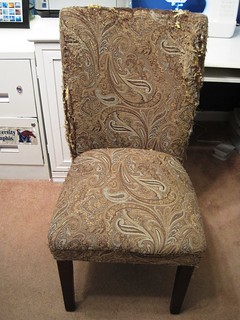

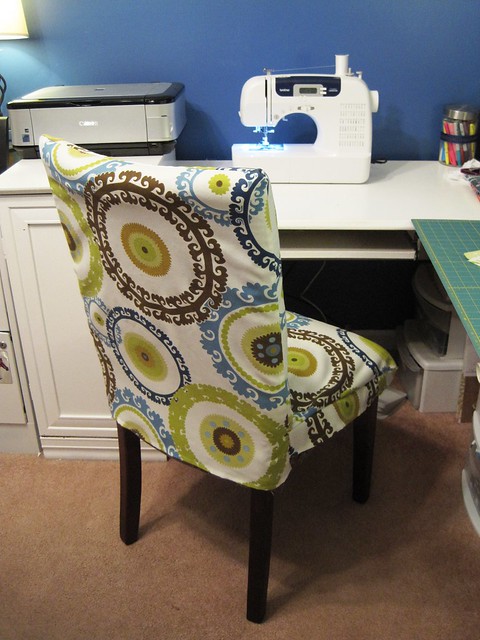
It took me almost three months, but I finally finished sewing a slipcover for the parsons chair in my office/craft room! I used this tutorial. Technically, I didn’t even finish it myself – my mom added the “skirt” piece for me after I sewed it on wrong TWICE. The skirt also came out too short. But the slipcover is done and on and it’s good enough for me, so…

I bought the parsons chair on sale a couple of years ago, and my cat Peach quickly made it her personal scratching post. At first I tried to stop her, but I’m already vigilantly protecting all my other furniture from her claws, and honestly, I gave up on this one. Besides, I figured I would want to change the look later anyway. This fabric is from the outdoor section at Hancock and I think it’s perfect for the room!
My other cat, Gandalf (who prefers clawing carpet over furniture), loves to hang out with me while I sew. He came right over to give the newly re-covered chair a head-butt of approval. ♥
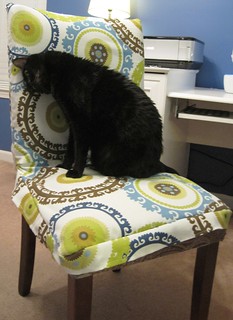
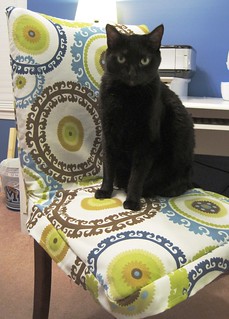
After taking these pictures, I had to cover the chair in clear contact paper to stop the cycle of destruction. It still looks fine, but isn’t the most fun to sit on. I’ll probably replace the contact paper with vinyl or something. Fellow pet owners, any better furniture-protecting ideas?
One more project done. Yay! :)
5 Comments + Posted in: cats, crafts